
(03.12.25) New AFFS research: levels of EDI spending significantly correlated to free speech non-compliance
In the first study of its kind, AFFS has evidenced a statistically significant correlation between levels of universities’ spending on EDI and levels of free speech non-compliance in their recruitment and promotion processes. While that correlation is (of course) not exact, it is pretty startling.
This Report compares 33 universities’ EDI spending with the extent to which they have to comply with their legal and regulatory duties to protect free speech in recruitment and promotion.
The findings are clear: the more a university spends on EDI, the more likely it is to be non-compliant with its free speech obligations.
This Report is a comparison of two previous pieces of work completed by AFFS, our 2023 Report on EDI Spending at UK Universities and our Report on University Compliance in Recruitment and Promotions. This is believed to be the first time this kind of analysis has taken place, and proves an undeniable relationship between EDI spending and free speech non-compliance.
What the data shows
The results of our comparison reveal a significant correlation between EDI Spending and institutional non-compliance:
- Universities which spend over £450,000 annually on EDI were overwhelmingly likely to be non-compliant with free speech requirements. In fact, all but one with spending above that figure had non-compliant recruitment or promotions practices.
- Universities spending below £450,000 were significantly more likely to be compliant: with the majority being found to be compliant.
- The relevant Russell Group universities both spent more, on average over £240,000 more – approaching double – on EDI, and were more likely to be non-compliant, with an average non-compliance rating 27.5% higher, than those of non-Russell Group members.
- A regression analysis shows that EDI spending is a predictor of free speech non-compliance at the 95% confidence level.
This reinforces what recent cases – as evidenced by the Dandridge Review into failures at the Open University – have already demonstrated: poorly structured or aggressive EDI agendas can result in direct breaches of universities’ legal obligations to protect free speech and academic freedom.
Why is this happening?
Concepts around EDI have expanded into a broad and often ambiguous set of goals, many of which go far beyond what equality law requires, the promotion and enforcement of which can actively infringe free speech rights.
At the same time, UK universities are spending huge amounts of money on EDI programmes and staff. Across just 40 universities, nearly £20 million was spent on EDI in 2023.
This friction, between EDI and free speech, creates very real problems for universities. As previous AFFS research has shown, many universities require job applicants to “demonstrate commitment” (inter alia) to EDI or impose duties on employees to actively promote EDI viewpoints. In both cases, these sorts of requirements and duties are highly likely to be in breach of multiple legal and regulatory requirements, as confirmed by the OfS. This can, as the University of Sussex recently found out, have serious financial and reputational repercussions.
Demonstrating the connection
To examine any relationship between levels of EDI spending and of non-compliance, universities were allocated non-compliance rating, based on the findings of our previous report, which were coloured to represent their severity: red for the worst offenders, to green to those found to be compliant. Universities’ levels of EDI spending was then coloured using the same numbers of colours as the compliance ratings.
The table below sets out the key findings of AFFS’s study, which is sorted by levels of EDI spending, clearly shows a broad correlation between EDI spending and non-compliance.
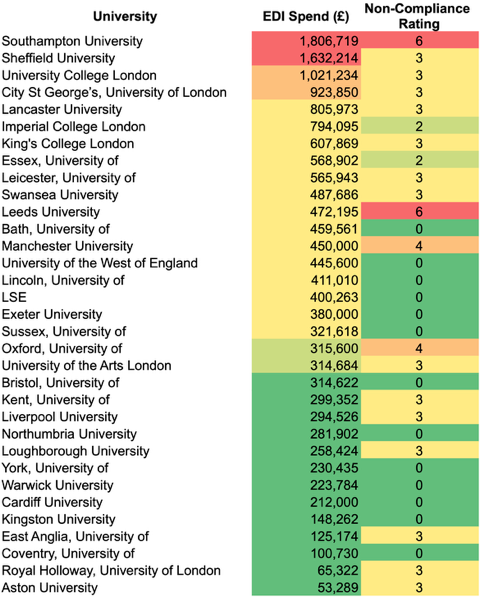
Thanks to Dr John Armstrong at Kings College London, a regression analysis of this data shows that EDI spending is a predictor of free speech non-compliance at the 95% confidence level.
AFFS’s study shows, for the first time, that high EDI spending is highly likely to produce environments where lawful dissenting viewpoints are discouraged or penalised, in this case in the context of university recruitments and promotions.
What’s more, given the prevalence of Russell Group universities at the top of the table, it is clear that Russell Group universities are, on average, spending more and are more likely to be non-compliant. This matches the figures, which show that non-Russell Group both were more likely to be compliant than, and underspent, those in the Russell Group: at 78.4% and 60.4% of the rate of Russell Group universities.
What universities need to do
To avoid the serious repercussions of non-compliance, AFFS urges universities to match any spending on EDI with:
- Increased care to secure free speech, and entrenched caution about, and care to avoid, possible consequent damage to free speech and indeed compliance failures;
- a commensurate increase of spending on free speech protection;
- their having a dedicated member (or members) of staff charged with ensuring that free speech and academic freedom receive attention commensurate with that received by EDI; and
- a university-wide policy of “institutional neutrality”, as recommended by free speech campaigners, referred to in the Dandridge Review and already implemented by a number of universities.
Read the full report here.